Evolution of the Game

I have three videos for you to watch. See if you can see the difference in how pickleball was played in 2016, was played in 2019 (a key inflection point in the sport), and in late 2023.

2016 US Open Bronze Medal Match – watch the first three points: https://youtu.be/9UVG5–LzZk?t=247

2019 Nationals Women’s Championship Match – watch the first point: https://youtu.be/tq4L0Ab3JTA?t=1403

2023 Nationals – watch the first point: https://youtu.be/xc3yaixseHY?t=80

The 2016 video is like watching traffic pass by a sign that says SPEED LIMIT 25.

The 2019 video is like watching traffic pass by a SPEED LIMIT 45 except that traffic is kind of out of control.

The 2023 video is like watching traffic pass by a SPEED LIMIT 65 sign with effortless braking and accelerating happening in real time.

All of those “soft skills” (drops, dinks) are still important, but the tool kit required to be effective is different seven years later, isn’t it?

Returns of Serve

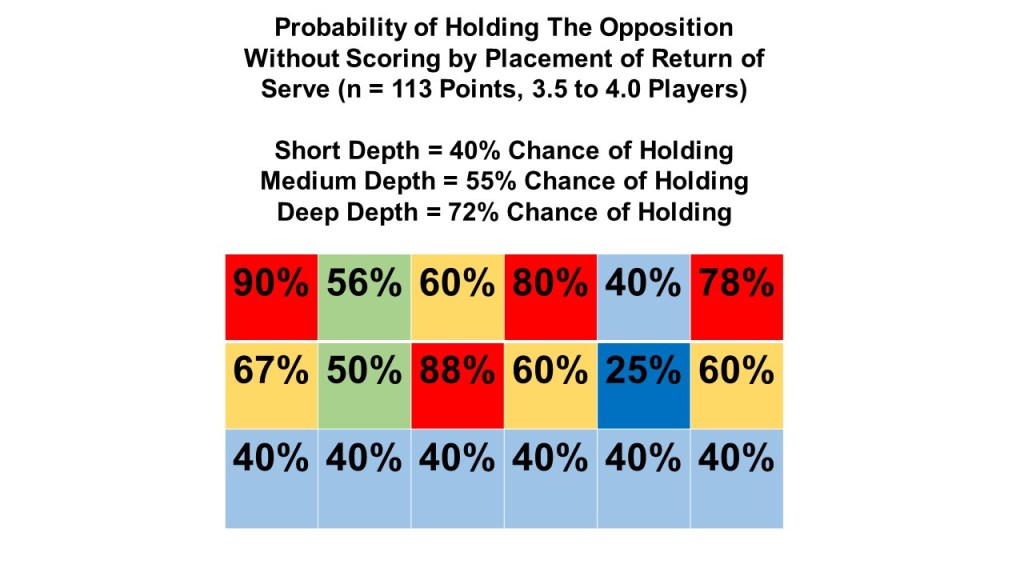
Hi #pickleball fans … I realize that 113 points is probably a small sample, but I charted the probability of holding the serving team without scoring a point based on placement of the return of serve.

Don’t return medium-depth to the forehand of a player (25%).

Try returning deep (obviously) and to either corner.

Improving depth of return of serve is worth about 2 points that you deny your opposition, per game.

Here’s What An Upset Looks Like

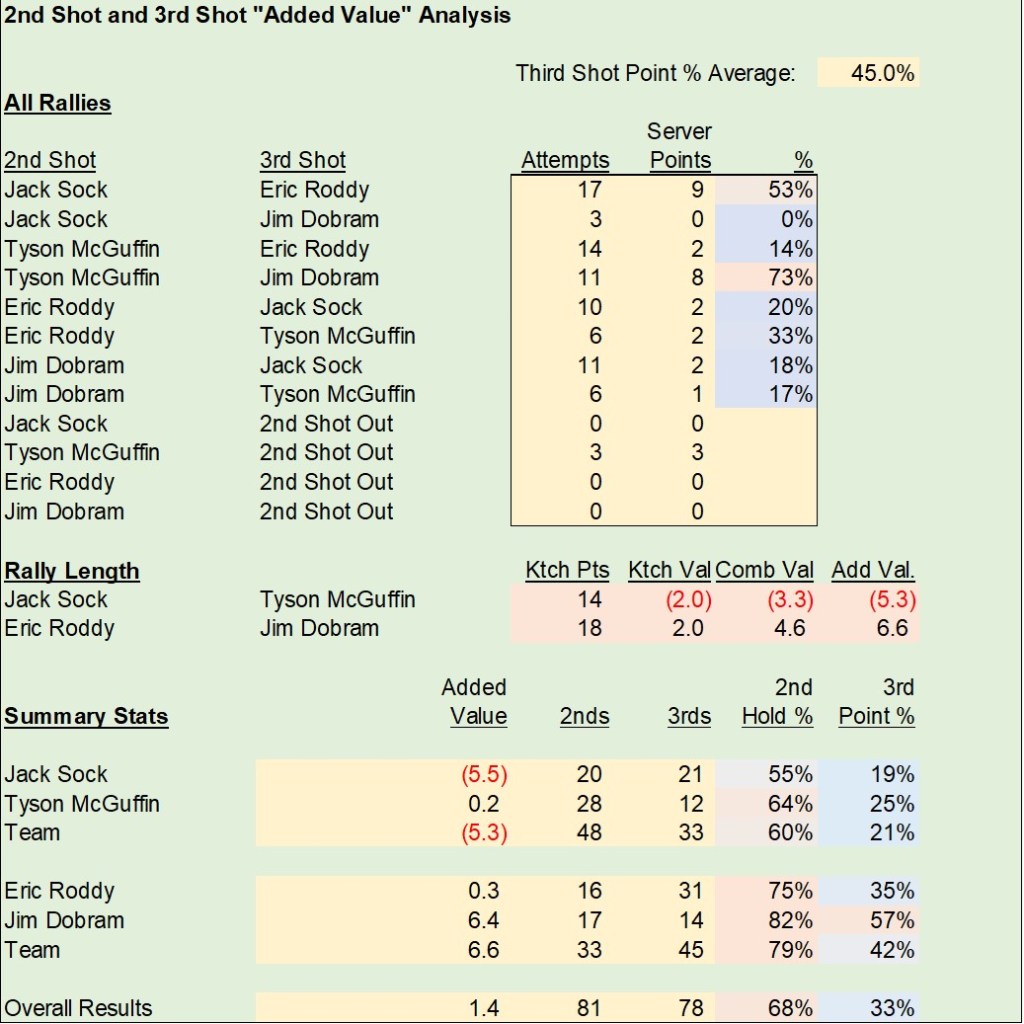
Yesterday McGuffin/Sock were blown out in the first round of the PPA event in North Carolina. Here is what the “Added Value” analysis looks like:

We see that Jack Sock was at -5.5 points of added value … while Jim Dobram was at +6.4 points of added value. This was ultimately the difference. McGuffin stuffing three returns of serve into the dumpster didn’t help matters. Sock’s team only scored 19% of the time when Sock attempted a third shot … well below the 40% – 45% average we see in typical PPA matches.

Look at the top portion of the table. In terms of 2nd/3rd shot combinations, McGuffin returned 11 serves to Dobram, and when that happened Dobram’s team scored a point 73% of the time. This was a big part of the formula for Roddy/Dobram’s win. Dobram’s play was key … when he returned the serve his team held 82% of the time … when he hit the third shot his team scored 57% of the time.

Roddy/Dobram would lose their next two matches … sometimes odd things happen in pickleball!

Added Value

Ok, I’ve spent the past half-year creating an analytics method that I’ve been sharing on Instagram (@minethatdata). I call the methodology “Added Value”.

The goal of “Added Value” is to demonstrate the contribution each play generates to the final score. If a team loses 11-7 / 11-7, there will be an approximate 4 points of “Added Value” going to the winning team, with an approximate -4 points going to the losing team. The methodology then parses added value among the four players, based on the outcome of returns of serve (holding on returns of serve is good and adds value), the outcome of third shots (scoring after attempting a third shot is good and adds value), and kitchen rallies won (winning kitchen rallies adds value).

Two weeks ago we watched as the Johns brothers lost to Phillip Locklear and Ben Newell. I performed an added value analysis based on the video published by Mr. Locklear’s wife: https://www.youtube.com/watch?v=k8FvfVWIZVw&list=PLVRe0e4He8wTpFWcuvoABGPsK1BiK7Rv1&index=24

Here is the Added Value analysis.

Go to the bottom of the table (labeled Summary Stats). Each player’s “Added Value” is illustrated. Ben Johns was at -0.5 points of added value, Collin Johns was at -6.0 points of added value, Ben Newell was at +3.3 points of added value, and Phillip Locklear was at +3.2 points of added value.

We can see how each player arrived at that value. When Ben Johns returned serves, his team held 55% of the time (about average). When Ben Johns hit third shots, his team scored 43% of the time (just below the 45% average I see in PPA matches). Hence, he was close to no added value. Meanwhile, Collin’s team held on just 41% of his returns of serve (below the 55% average in PPA matches), and Collin’s team scored on just 23% of his third shots (below the 43% average in PPA matches).

The data indicates that Ben/Phillip contributed equally to success … both holding at above-average rates, both scoring off of thirds at above-average rates.

This style of analysis works even better with amateur players, FYI. It is a good methodology to demonstrate why a team wins a match. It’s taken more than a year to get to this point, and I’m confident this framework can be used to analyze matches going forward!

Mens 4.0 35+ 2021 Nationals

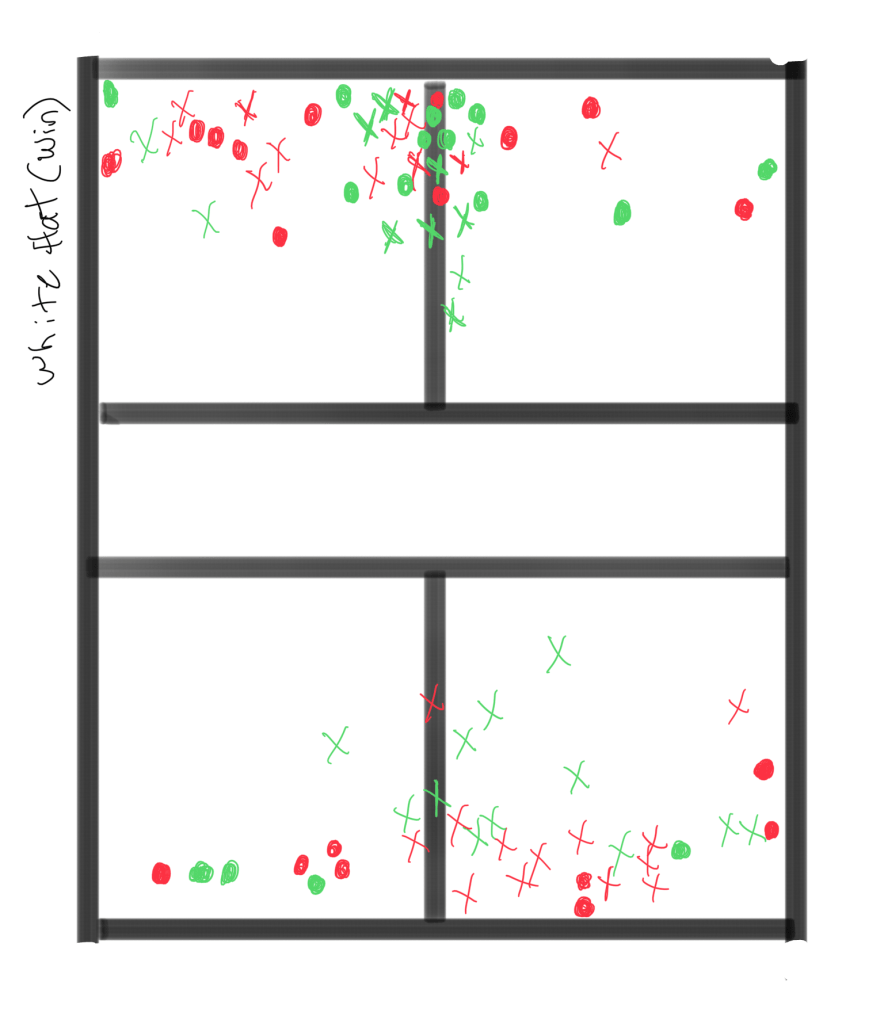
Here is the shot chart for 3rd shots from the Mens 4.0 35+ Gold Medal match at the 2021 Margaritaville National Championship. https://www.youtube.com/watch?v=c9a4w6qU0ZA

The team that won the match (in two games) is shown at the top of the image. Here is the code for the image:

  • Circles are Drop Shots.
  • X’s are Drives.
  • Green Color = Team Won The Point.
  • Red Color = Team Lost The Point.

Tell me what you see when you look at the image?

Let’s analyze the top portion of the table. The winning team is depicted at the top of the table. Visually, you can see that they hit a lot more drop shots. When they hit drop shots from the middle of the court, they won 9/12, 75%. Drop shots from the outsides of the court led to points 3/11 = 27%. Drives can be divided into four sections on the court … back right, back middle, back left, short middle. Back Right Drives converted at 2/7 = 29%. Back Middle Drives converted at 4/10 = 40%. Back Left Drives converted at 0 for 1. Short Middle drives converted well, at 5/5 = 100%.

The team that lost is depicted at the bottom of the image. Their 3rd shot profile is different, mixing in a lot more drives than the team that won. This team didn’t attempt any drop shots in the middle of the court – they saw these balls as an opportunity to drive the ball. Left side drops converted at 3/7, 42%. Right side drops converted at 1/5, 20%. Overall their drops converted at 4/12, 33%, their opposition converted at 12/23, 52%. So yes, a solid soft game including quality third shot drops matters!!

Let’s evaluate their drives … the losing team (bottom) drove a lot of balls (25 out of 37 third shots were driven). However, their probability of success was less when driving from the baseline (5/16, 31%) whereas their success driving short returns of serve was great (7/9, 78%).

Both teams had significant success on short returns of serve. The winning team (the guy with the white hat) scored 8/11 (73%) on short returns … the losing team (orange shirt guy) scored 7/10 (70% on short returns). Yes, a deep return of serve matters a lot. Deep returns of serve converted at 43% for the winning team, 33% for the losing team.

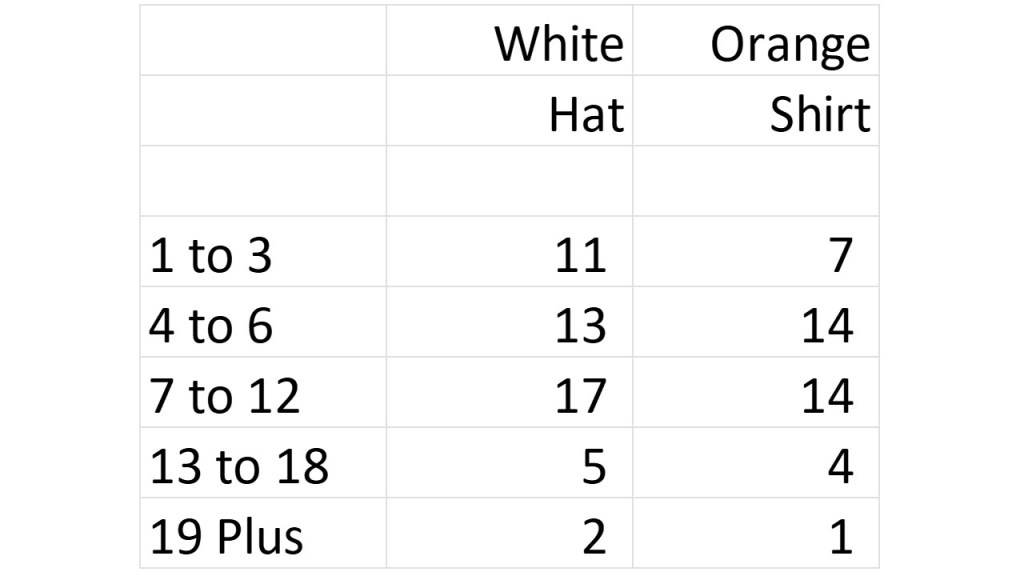
Rallies were not particularly long. Both teams were willing to drop/dink when necessary, but they attacked persistently. Here are the number of points won by rally length.

The winning team (White Hat) controlled the match at all levels of point depth with the exception of 4th/5th/6th shots – in those cases, the losing team hit drives that were difficult to return/attack.

More than half of all points ended within six shots (45 points out of 88).

Seventy-seven percent of points ended within ten shots. Both teams attacked relentlessly, slowing down when there were few options to pressure the opposition. Drops / Dinks matter, absolutely. Putting pressure on the opposition matters as well. We have to be good at both. The difference in this match came on quality third shot drops for the winning team – they converted those shots at a higher rate than their opposition did with baseline drives on third shots.

Drive those short returns of serve to the middle of the court.

Drop those deep balls.

Tuesday Night Pickleball

Devilliers/Grechkina thumped P. Smith/Jansen last Tuesday night at The Orchard.

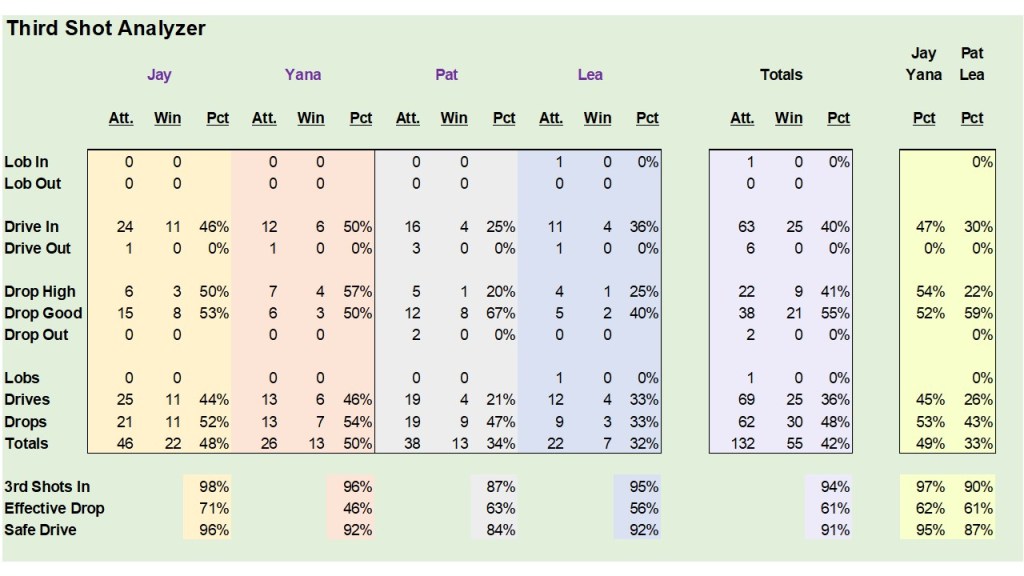
I tracked success of third shots.

There’s a lot of stuff going on there.

If you look at Patrick’s stats, you can see reasons why they lost. When he hit a drive, he and Lea only won 21% of their points … Lea won 33% on her drives. Meanwhile when Jay hit drives, his team won 44% of points, when Yana hit drives, her team won 46% of points. Presumably Jay was able to clean up a lot of trouble following drives.

Pat Smith hit five thirds out … three drives and two drop shots, meaning just 87% of his thirds got over the net and were consequently hit by the opposition.

Effective Drops (taken off the bounce or with paddle below wrist) were interesting … Yana only hit 46% effective drops, but her/Jay scored on 57% of non-effective drops. Digging balls out of the transition zone is an important skill to master.

Across all four players, 41% of non-effective third shot drops resulted in a point.

Across all four players, 55% of effective third shot drops resulted in a point.

Intuitively, one would think that, yeah, getting your third shot drops down is a good thing, and it is a good thing. However, there were 22 third shot drops that were not effective … the math shows that 22 * (0.41 – 0.55) = 3 points … just three points … were lost by all four players across both games because third shot drops weren’t effective.

This is where life gets interesting …. if a player were to hit a lot of third shot drops into the net, the player would theoretically be more incented to hit thirds high, as the math would yield a better outcome.

Think of it this way. Say you play two games, winning each game 11-8. Say that a high third gives you a 40% chance of winning a point, an effective third gives you a 55% chance of winning a point. Say that 60% of the drops that get over the net are “effective”. Your team hits 50 third shot drops in the match. We can see how many “expected points” are generated based on how many third shot drops do not get over the net.

Let’s assume 60% of drops are effective, but 10% of drops hit the net. Expected Points = 50*0.10*0.00 + 50*0.90*(0.60*0.55) + 50*0.90*(0.40*0.40) = 22.05 expected points.

Let’s assume that 60% of drops are effective, but 20% of drops hit the net. Expected Points = 50*0.20*0.00 + 50*0.80*(0.60*0.55) + 50*0.80*(0.40*0.40) = 19.60 expected points.

Now, let’s pretend that 35% of your drops are effective, but none of the drops hit the net … they all get over, but most of them are high. Expected Points = 50*0.00*0.00 + 50*1.00*(0.35*0.55) + 50*1.00*(0.65*0.40) = 22.63 expected points.

In other words, you are better off with a lousy third shot drop that gets over but does not hit the net.

Think about that one the next time somebody tells you that your thirds shots aren’t good enough.

Deep Returns of Serve

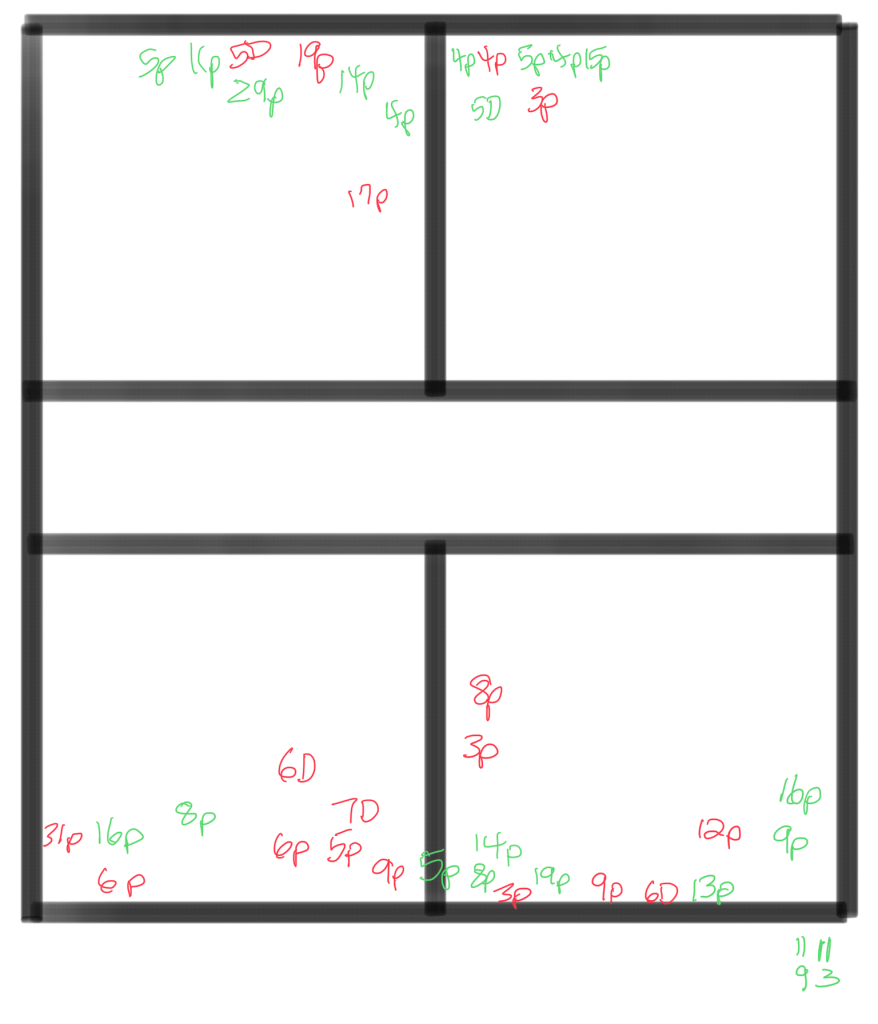
This image comes from a PPA Team Championships match on Saturday. I marked where the return of serve landed. Red means the team attempting the third shot lost the point, green means the team attempting the third shot won the point. An “X” means the team attempting the third shot hit a drive, a filled circle means the team attempting the third shot hit a drop.

Top half of the image is where McGuffin/P. Smith were playing … bottom is where C. Johns / S. Smith were playing. Colin Johns hits a lot of drop shots, many of those with his back hand.

Most interesting is where the returns of serve land. They’re deep, aren’t they?

I mean, really deep!

Us mere mortals don’t generally have that level of success on returns of serve.

3.5 60+ Nationals Final: Rally Analysis

Ok, here’s the video: https://www.youtube.com/watch?v=9JuA0PItgvM

The first thing you’ll see is the power of the spin serve … going away in 2023 as I understand.

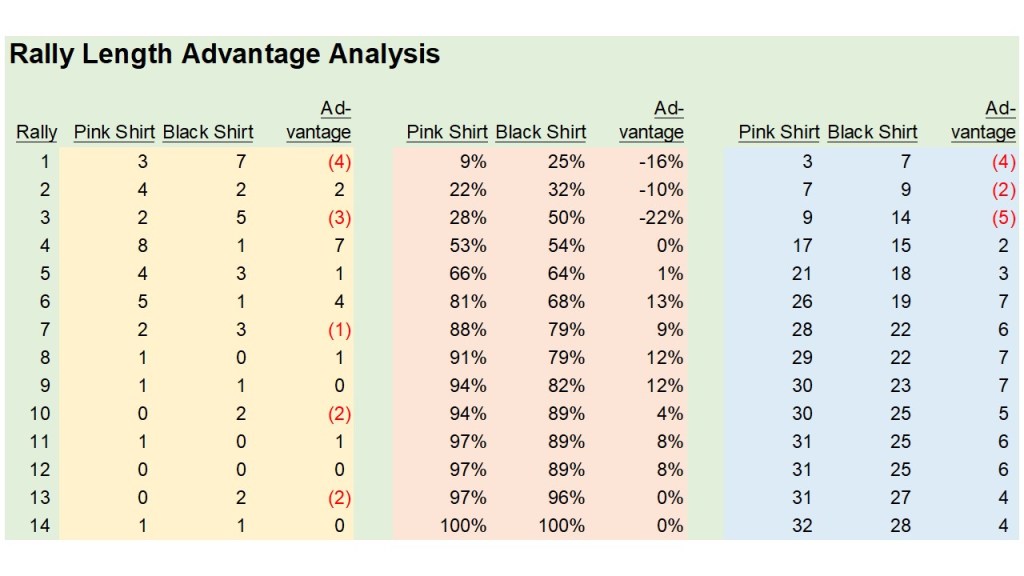
Here’s the shot chart … the team that wins Gold is called “Pink Shirt” … the spin serve guy is called “Black Shirt”.

Black Shirt Team won 7 serves without a return, and won 2 serves where the ball did not make it back over the net. On third shots, Black Shirt Team had advantages due to the power of the guy’s serve. In total, Black Shirt Team won 14 points while Pink Shirt Team won 9 points on the first three shots.

On Shots 4-6, Pink Shirt Team has a huge advantage, outscoring Black Shirt Team 17-5. Seventeen to Five! The guy in the pink shirt had nice 3rd shot drives that he could parlay into good 5th shots … causing errors on 4th/6th shots. Watching the match, it’s easy to see how critical it is to put pressure on the opposition on 3rds/5ths … it’s not just important for Ben Johns, it’s important for Pink Shirt Guy as well!

If points went beyond a 9th shot, Black Shirt Team performed better, holding a 5-2 advantage.

Overall, Pink Shirt Team held a 32-28 winning advantage. Take out the nasty serve that Black Shirt guy had, and Pink Shirt Team held a commanding 23-14 edge.

Rally Length Analysis continually suggests the importance of the 3rd/5th vs. 4th/6th strategy. Teams that control the 3rd/4th/5th/6th shots have an advantage, based on the analyses I’ve conducted.

Rally Length Analysis

The Johns brothers played yet another Championship Match against Newman/Wright on Sunday, winning in four games.

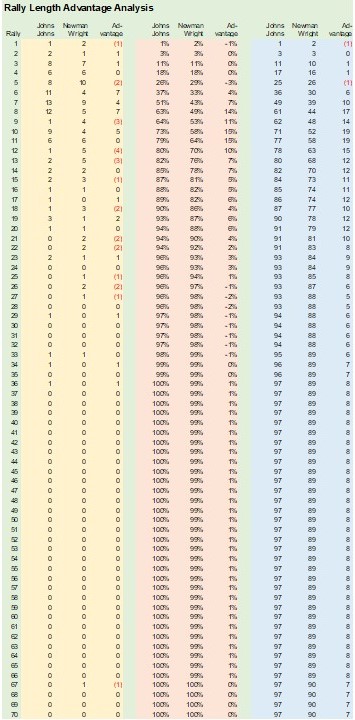
In this match, I charted the team that won the point based on rally length. Here are the results.

On the far left side of the chart, we see rally length (1 to 70).

The yellow section tabulates how many times each team won after a rally of “x” shots.

The salmon section measures the cumulative percentage of wins for each team by rally length. For example, Johns/Johns won 79% of their points on or before eleven (11) shot attempts, whereas Newman/Wright won 78% of their points on or before fourteen (14) shot attempts.

The blue section cumms winning points by shot attempt. In the match, Johns/Johns won 97 total points, Newman/Wright won 90 total points.

Ok, you’ve had a chance to view the data. Where did Johns/Johns control this match?

Well, the outscored Newman/Wright 46-26 on rallies that lasted 6-10 shots. Short rallies (1-5 shots) were 26-25 in favor of Newman/Wright … long rallies lasting 11+ shots were 38-26 in favor of Newman/Wright.

When Ben Johns controlled points on the fifth shot and beyond, Johns/Johns performed well. If Newman/Wright could outlast the onslaught from Ben Johns, they controlled points thereafter.

In my analyses, the players controlling the “middle” of points (typically 5th shots through about 12th shots) tend to win matches. This finding may change as I analyze more matches, but that’s what I’ve observed over the past few months.

Pickleball Lies: Errors While Serving

On multiple occasions I’ve heard experts say that if you are going to make a mistake, make it when you are serving, because the other team cannot score.

That’s a lie.

Of course the other team cannot score. But when you make a mistake while on the serving team, you take away the opportunity to score future points.

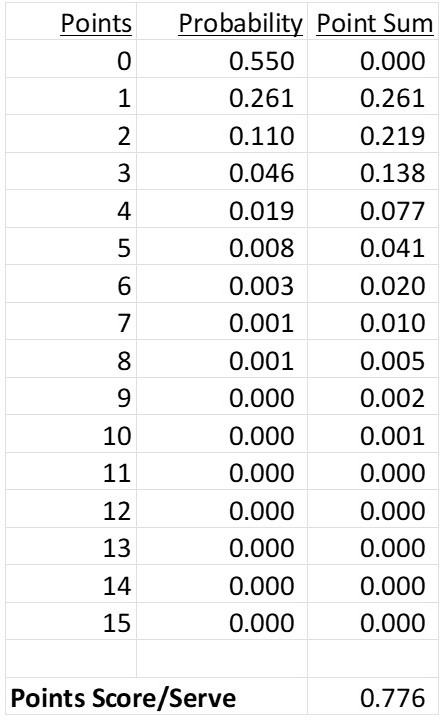
I’ve charted numerous PPA matches … in 2022, the serving team has a 45% chance of scoring a point when serving in the (1) position, and a 45% chance of scoring a point when serving in the (2) position. This allows me to create a distribution of expected points from an individual server, and a team. Your mileage will vary.

Say I am serving and the score is 0/0/1. How many points can I be expected to generate while I am serving?

55% of the time I will not score a single point while I am serving.

26% of the time I will score one point.

11% of the time I will score two points.

8% of the time I will score 3+ points.

In total, I can be expected to score 0.776 points when I am serving.

So when I air mail my serve out the back, I cost my team 0.776 future points. Sure, we might have lost the point, so nothing is lost. But we might have scored 3 points off of my serve, and we’ll never know if we would have scored those three points.

Remember – you cannot win unless you get to 11 points. You cannot waste points while serving.

The logic doubles when both players get to serve … you can expect to score 1.552 points off of your two serving chances.

Little details matter. If you increase your odds of scoring a point from 45% to just 48%, you increase the expected 1.552 points off of both of your serves to 1.655 points. Over the course of a game, that equates to about 0.7 points. Increase your odds to 50%, and you’ll score 1.724 points off of both of your serves.

You’re being told to worry less about making mistakes while serving. That is incorrect. If anything, your odds of winning increase if you are more thoughtful about mistakes while serving, increasing the expected number of points you’ll score, getting to 11 faster.

Tuesday Night Pickleball

Here’s a link to the event last night at The Orchard (click here).

I tracked a handful of metrics. After watching in-person, it seemed like there were a lot of step-backs on fourth shots off of third shot drops. So I counted ’em.

4th Shot Step Back = 25, 37% of total.

4th Shot Bounce = 13, 19% of total.

4th Shot Low Reach = 19, 28% of total.

4th Shot Attack = 10, 15% of total.

Drop shots were quite good, with 85% being effective. The pros appear to try to alter the math by taking 25 of 57 good drops (44% of them) and turning them into offensive opportunities by stepping back then putting pace on the 4th shot.

When watching in-person, it looked like Dizon/Newman were more effective as a team when Dizon was in the forehand position. So, I tracked points won/lost when Dizon was on forehand vs. backhand. The data “kind of” bears this out.

Dizon on Serve, Left Side = 33% of points won.

Dizon on Serve, Right Side = 38% of points won.

Dizon on Return, Left Side = 58% of points won.

Dizon on Return, Right Side = 49% of points won.

When serving, if Megan was on the left side, she hit 3rd shot drives into the net and overcooked a few balls out the back, lowering her scoring percentage.

However, when Dizon/Newman were receiving, Megan had a better scoring percentage on the left side by being able to attack a bit more on 4th shots / 6th shots. Had they stacked on return of serve, they would have stopped Jones/Smith from scoring two points per game … potentially enough to alter the outcome of the first game.

Little things matter in Pickleball.

More 3rd Shots

Back to our APP tournament, this is a semifinal with Patriquin/Stone … they defeated McMakin/Taylor 11-9 / 11-3 (click here to watch the match).

This time, I charted drops (ending with a small p) and drives (ending with a capital D) and prefixed the letter with the number of shots it took to win/lose the point. In other words, 13p in green means that the player hit a 3rd shot drop and it took 13 hits to win the point … 9D in red means that the player hit a 3rd shot drive and it took 9 hits to lose the point.

Here’s the chart … the bottom half is Game 1 (11-9 win) … the top half is Game 2 (11-3 win).

First of all, look at how effective the returns of serve against Patriquin/Stone (I’m only charting their third shots). Those balls are DEEP!!!!

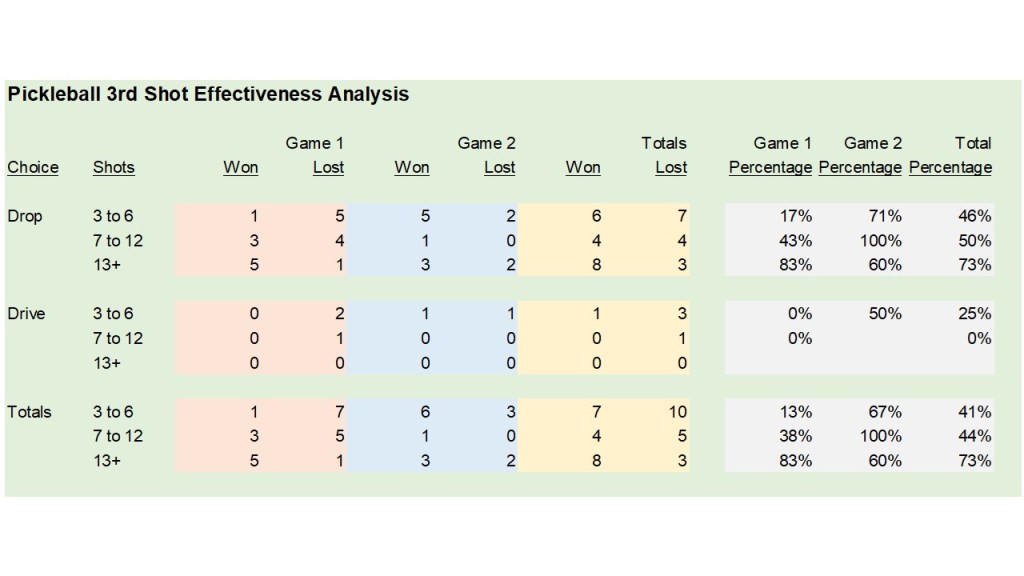
Let’s see if a summary of the data tells us anything.

There’s a little bit of a story here. They attempted 32 drops vs. 5 drives, and if the drop rallies went 7-12 hits they won 50% of the points. If the drop rallies went 13+ shots, they won 73% of the points. Since the returns of serve were so deep, the key to winning was to hit drop shots that bought time to get to the kitchen, where the duo had an advantage if the point lasted 13+ shots.

But my goodness, look at how far they were pushed back to hit their 3rd shots!

Drives vs. Drops

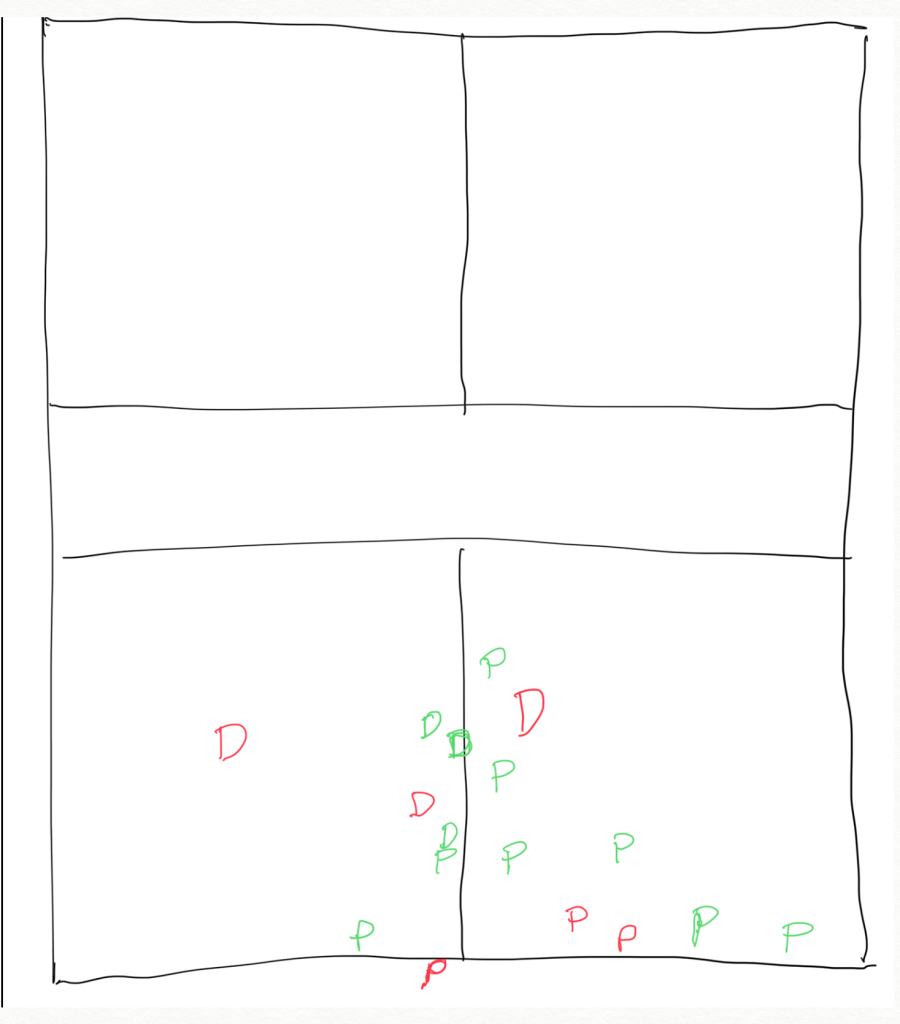
The chart below is for the first game in the APP Sacramento event held over the weekend, charting Hayden Patriquin and Wyatt Stone’s 3rd shot attempts. The chart shows Drive (D) and Drop (P) attempts, red coloring means they lost the point, green coloring means they won the point.

Notice where the drives happen – they’re pretty disciplined, hitting drives in the middle of the court (middle depth, along the center line). Drops are hit back near the baseline.

Drive Success = 3 of 6, 50%.

Drop Success = 8 of 11, 73%.

Drop Success at the Baseline = 3 of 6, 50%.

Drop Success in front of the Baseline = 5 of 5, 100%.

Rip those mid-depth / center returns of serve.

Notice that drop success increased as they got away from the baseline … we’d expect this to be the case.

First Three Shots & Errors

Ok, this afternoon’s film study charted when players won points. This time, I split out what happens on shots 1-3 vs. shots 4-6. If you miss a serve, if you miss your return of serve, or if you hit a 3rd shot drop into the net (or a drive out the back or into the net) you essentially cost yourself a point … technically, you cost yourself a half-point because maybe you “could” have won the point otherwise.

Let’s look at both of the APP Bronze Medal matches from this afternoon.

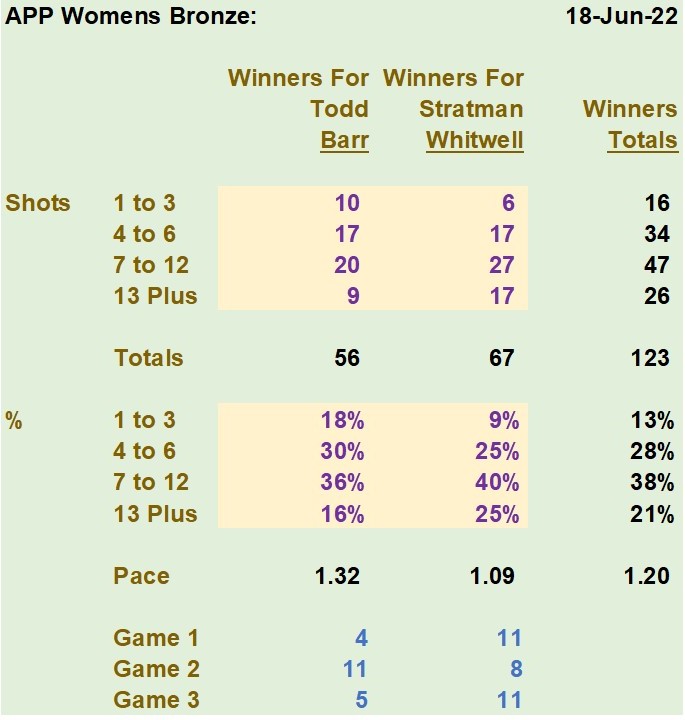
Look at the Women’s Match first. Stratman/Whitwell controlled the match by winning mid-length and long points. Todd/Barr performed well by scoring four additional points off of errors on 1st/2nd/3rd shots, and by winning points on the 4th/5th/6th shot.

I didn’t expect 13% of points to be determined via errors on the 1st/2nd/3rd shot. That’s 1/7th to 1/8th of all point determined by simple errors.

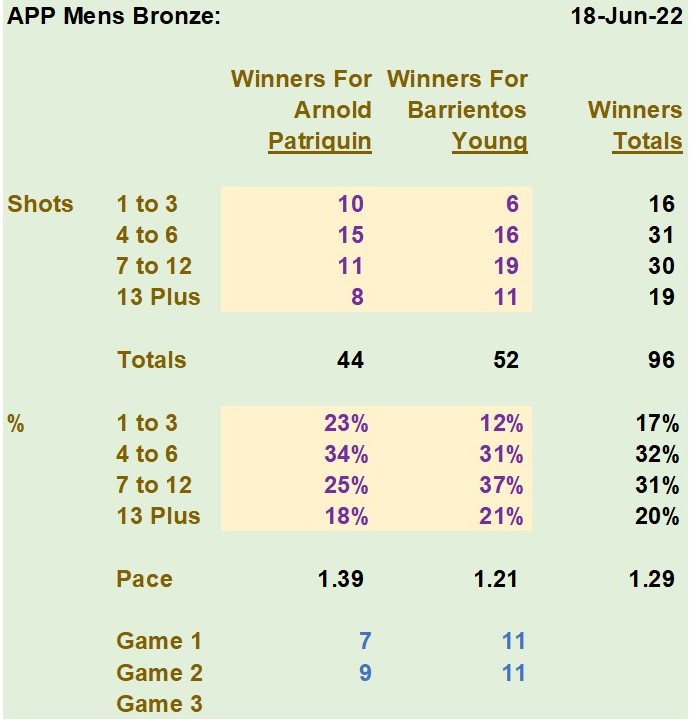
How about the Men’s Bronze Medal match? 17% of points were determined by errors on the 1st/2nd/3rd shot. 17%!!

Between the two matches, one out of every seven points is won by a team watching the opposition make a 1st/2nd/3rd shot error.

Thereafter, the Men’s Match was controlled by Barrientos/Young. They won more points on shots 4-6, they won a lot more points on shots 7+. They were able to grind out points. Outside of being -4 on point differential in shots 1/2/3, they were dominant.

The point of this charting exercise? We’re going to learn that the first six shots are important, for different reasons. Shots 1-3 are about setting up combinations without making errors. Shots 4-6 are about finishing off combinations. Shots 7-12 transition into dinking rallies, with the long ones finished off in 13+ shots.

Data Points: The Six Shot Rule

The hypothesis I’m developing is that points are frequently decided in the first six shots, by putting constant pressure on the opposition. Once we get to the 7th shot, things devolve into a dinking rally, and then speed up at once the first attackable ball is offered.

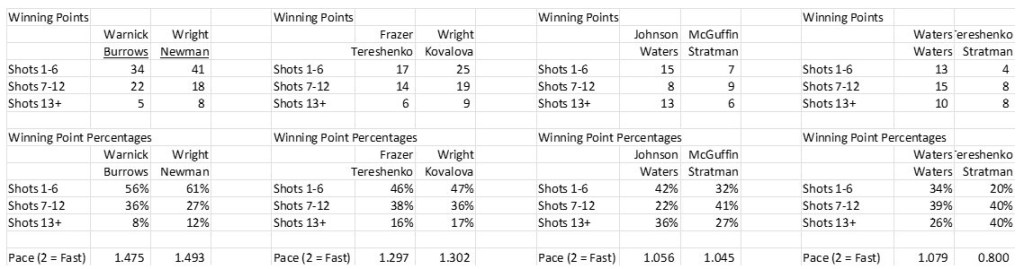
I measured when points were won in four PPA matches from Orange County.

Warnick/Burrows vs. Wright/Newman

Frazer/Tereshenko vs. Wright/Kovalova

Johnson/Waters vs. McGuffin/Stratman

Waters/Waters vs. Tereshenko/Stratman

So yes, there’s likely a “small sample size” issue here.

I tabulated shot shot that resulted in a winning point. Then, I summarized all points from the match, and created a “Pace” metric that assigns a value of “2” to points that end after 1-6 shot, “1” to points that end after 7-12 shots, and “0” to points that end after 13+ shots. “Pace” helps us see what the tempo of the points are … are the points grinding (value 0-1.1ish), or are the points ending quickly (value 1.3+).

Here’s what I learned across the four matches.

The Warnick/Burrows vs. Wright/Newman sets the tone for high-paced points, with Wright/Newman winning 61% of their points within six shots. Only about 10% of the total points were won via grinding out points via dinking. Wright/Newman outperformed Warnick/Burrows by a 61%-56% (41-34) margin on winning points within six shots.

Wright/Kovalova easily won their match, with both teams scoring similar percentage of points by 1-6 shots, 7-12 shots, and 13+ shots.

Johnson/Waters easily won their match, but Johnson/Waters dominated short rallies (42%-32%) and long rallies (36%-27%).

The Women’s match was dominated by the Waters. The Waters dominated short rallies (34%-20%), while Tereshenko/Stratman had a bigger share of winners from long rallies … unfortunately, the Waters even outscored them on long rallies (10 winners to 8).

Let’s sum up the totals for all four matches.

Points Won Within Six Shots: Winning Teams = 24 Points Average. Losing Teams = 16 Points Average.

Points Won 7-12 Shots: Winning Teams = 15 Points Average. Losing Teams = 13 Points Average.

Points Won 13+ Shots: Winning Teams = 10 Points Average. Losing Teams = 6 Points Average.

Winning teams in the four games I tabulated results for had an eight point edge on winning points in the first six shots, a 2 point advantage winning points on shots 7-12, and a 4 point advantage winning points on shots 13+.

The “Six Shot Rule” is pretty darn important. The first six points include challenging serves, attacking second shots, an increasing mix of third shot drives in 2022, and attacks on 4th/5th/6th shots. If the point isn’t won by the sixth point, the flow of the game settles into a dinking rally, on average.

One final point … look at the “Pace” metric I created … what do you see for Stratman/Tereshenko? Neither player was able to generate enough offense early in a point, meaning they had to grind if they were going to win points. I’m not saying this is bad … this may have been their only chance to win. But offense/pressure are the theme of 2022, and Stratman/Tereshenko struggled to generate offense/pressure against the Waters.

Speaking of Pressure

Last weekend the PPA played in Orange County. If you want to see what “pressure” looks like in the game of Pickleball, give Burrows/Warnick vs. Newman/Wright.

In case the match doesn’t load properly, go to the 2 hour 37 minute spot to begin watching the match. https://youtu.be/HFRxpJMjKIQ?t=9452

You’ll see plenty of application by Burrows/Warnick of what I call the “Six Shot Rule” … where you put a ton of pressure on your opposition in the first six shots, before settling into dinking (if you get to the 7th shot).

You’ll also see a ton of chatter on the court, which makes things spicy.

Notes from Film Study from the Past Five Weeks

Here are some notes based on what I’ve observed over five weeks of film study of PPA and MLP matches.

Serves:

  • Deep, with pace, often to a backhand, with spin.
  • Trying to create an uncomfortable return of serve.

2nd / Return of Serve:

  • Non-receiver positions near center line.
  • Deep where possible.
  • Deep keeps opposition from crashing middle for shake-n-back opportunity.
  • Down the line(s) to keep “shake-n-baker” away from engaging on a 3rd shot. A shot down the line might force shake-n-baker to take the 3rd shot with a backhand, eliminating the shake-n-bake opportunity.
  • Down the line returns of serve create space for 4th shot put-aways.
  • In other words, keep the poacher / aggressive player busy with shots s/he doesn’t like.

3rd Shot:

  • Drive or Drop.
  • Player not attempting the third shot crashes middle unless return of serve is too deep, at which point a drop is attempted and then the team tries to earn way up to the kitchen together, tethered.
  • By crashing, you force a team hitting a 4th shot into making less-optimal choices. They cannot really speed up because the shake-n-bake will beat the team hitting a 4th shot. You force team hitting 4th shot to take the bait and hit ball to the player hanging back.
  • Drives are often hit wide (and to a backhand) to create an extra foot of space to open up the middle.
  • Game has changed – 3rd shots are now used to create pressure, with both players creating a pressure via court positioning and shot selection/direction.

4th Shot / 6th Shot / 8th Shot:

  • Hit behind the 3rd shot crasher to take crasher out of favored position in middle of court. Move the player wide, keep him/her busy.
  • If return of serve keeps 3rd shot team back, 4th shots continue to keep ‘em back. Deception is used to change angles and pace given that put-aways are hard. Do not let the other team get up to the kitchen. Deception / Mis-Direction is used against player who crashes up for a shake-n-bake opportunity.
  • Women are not afraid to use two-handed backhands to create pressure/power.
  • Players slide away from their forehand to hit a forehanded shot, generating more power, especially men. No need to be lazy and stand in place and hit a backhanded punch when you can generate power by sliding two steps left and hitting a forehand (right handed) shot (opposite for left-handed players).
  • Step-backs happen on 4th shots, letting ball bounce in kitchen and then seeking a speedup opportunity on a 4th shot. I’m seeing more of this and less taking the 4th shot out of the air following a 3rd shot drop – this creates more pressure.
  • Go after the feet of the 3rd shot crasher.
  • Inside-out plays are heavily utilized to generate winners down the sideline.

5th Shot / 7th Shot / 9th Shot:

  • Increasingly seeing 3rds that are drives followed by 5ths that are drives, if 4th shot is knocked down. Pressure!
  • Goal is to get to the kitchen after a 5th shot, with patience following a 3rd shot. It might take a 7th/9th to get there.
  • Shake-n-bake player is prepared to come all the way to the right to finish a point, while support player is ready to cover remainder of the court (right-handed situation).
  • Women are not afraid to use two-handed backhands to create pressure/power.
  • Resets/Blocks off of powerful 4th/6th/8th shot to get up to the kitchen, attempting to drop ball into the kitchen. On balls you can handle, you’ll eventually hit a successful drop shot. Drop shots have become less important on 3rd shots, and are very important on 5ths/7ths/9ths, becoming extensions of dinks as you get closer to the kitchen. Odds of a successful drop increase as you get closer to the kitchen. Pros seem to be playing odds to get drop shots that have a higher percentage of a chance of landing harmlessly in the kitchen.
  • If you are the crasher, back the heck up if opposition comes after your feet.

The game evolved in the past 2-3 years on 1st/2nd/3rd/4th/5th/6th shots. There is much more aggression and pressure being applied, on both sides of the court. We have to evolve as the game changes.

After the 5th/6th shot, the game still devolves into a dinking rally. About 35% of points get to this stage, a significantly lower rate than in the past (among pro players).

Dinking Rallies:

  • Much more offensive than 2-3 years ago.
  • More pace.
  • Both rolls (topspin) and cuts (backspin).
  • Constantly moving players side to side, looking to create space.
  • Pressure applied to get players to move a step back from the kitchen.
  • Dinking wide to keep poacher (happens a lot to males in mixed play) occupied and away from the middle of the court. Like keeping Ben Johns wide with dinks so he cannot dominate middle of the court.
  • Better player covers 2/3rd or more of the court. Not a 50/50 proposition. Applies to most aspects of pickleball, not just dinking. Court is no longer shared.
  • Many “Ernie” movements, just to give opposition pressure and something to think about.

Speedups:

  • Speedup is generally not a put away. Used to create a “hitting down” advantage on other team who is forced to “hit up” on the ball.
  • Present speedups to the middle with your paddle, then deception is used to go elsewhere. Goal is to get opposition to collapse to the middle, creating space on sides for the mis-direction.
  • Reset / Reset / Reset!!! Get out of the gunfight if you are hitting up on the ball.
  • Body shots are generated off of deception/mis-direction.
  • Inside-outs are useful if you have time.

Those are my observations. What are you observing in 2022?

Serves, Returns of Serve

In Major League Pickleball this morning (Saturday), Camryn Irwin (who is an absolute joy to listen to) and Adam Scott discussed serves and returns of serve.

Mr. Stone wondered aloud what percentage of returns of serve are deep based on the depth of the serve. Well, that is a question that can be answered.

For the four games of the Florida Smash vs. Mad Drops match, I charted depth of serve and depth of return. Here’s what I learned.

1 Serve Was Hit Long.

Short Depth Serve = 100% of returns are deep (7 of 7).

Medium Depth Serve = 48% of returns are deep (26 of 54).

Deep Depth Serve = 38% of returns are deep (38 of 101).

Total Deep Serves = 62% deep (101 of 163).

So yes, Mr. Stone, the depth of a serve impacts the depth of a return of serve!

Film Study: Andrea Koop

Let’s take a look at some of the things that Andrea Koop does well. She’s able to win with different women. She’s able to win with different men. She medals in APP tournaments, in PPA tournaments, it just doesn’t matter, she medals. And she doesn’t play full-time either, given that she has a full-time job.

Ok, here’s the match we are going to study: https://youtu.be/zKKYhCzmbJA?t=4371

We start with a deep return of serve, which keeps the opponents back – and once everybody gets to the kitchen Andrea is not afraid to dink backhanded from the right side of the court, setting up Simone: https://youtu.be/zKKYhCzmbJA?t=4390

This point is lost, but notice how many times Andrea uses a two-handed backhand … return of serve, blocking, and going on offense: https://youtu.be/zKKYhCzmbJA?t=4543

Notice how Andrea usually goes cross-court on dinking rallies, but in this case she is on the right side of the court, goes toward the middle, dinks her opponent into a corner and that creates a popup resulting in a point: https://youtu.be/zKKYhCzmbJA?t=4586.

Andrea disguises the placement of her put away on this point: https://youtu.be/zKKYhCzmbJA?t=4703. We see this repeatedly among the pros – they present the paddle but do not present the angle the ball will be hit at.

Look at the power she generates on two-handed backhands: https://youtu.be/zKKYhCzmbJA?t=4724

At the kitchen, Andrea can take balls in the middle because of her ability to create offense with her two-handed backhand. https://youtu.be/zKKYhCzmbJA?t=5028

She takes dinks out of the air, putting pressure on the opposition: https://youtu.be/zKKYhCzmbJA?t=5153

She loses the point, but again, look at how she creates offense with her two-handed backhand: https://youtu.be/zKKYhCzmbJA?t=5326

They lose the point again, but I want you to see how Andrea steps up and cuts off half of the court as the third shot begins, allowing Simone to take all of the balls as she earns her way up to the kitchen. Most pros use this tactic. https://youtu.be/zKKYhCzmbJA?t=5559

Too high 3rds/5ths … pros make mistakes: https://youtu.be/zKKYhCzmbJA?t=5896

She loses again – but my goodness, she stays in the backhand and comes over in front to Simone to keep engaging in the point (which ultimately haunts her): https://youtu.be/zKKYhCzmbJA?t=6334

More offense off of a two-handed backhand: https://youtu.be/zKKYhCzmbJA?t=6596

Defense and Patience: https://youtu.be/zKKYhCzmbJA?t=7215

Success starts with offense off of the two-handed backhand: https://youtu.be/zKKYhCzmbJA?t=7461

On dinking rallies, Andrea frequently takes dinks back-handed via the “respect the ‘x'” philosophy: https://youtu.be/zKKYhCzmbJA?t=7520

The takeaway from our film study? Andrea is able to create a lot of offense off of her two-handed backhand. A LOT of offense! On dinking rallies, she takes a lot of balls backhanded, allowing her to maintain coverage over the middle of the court – she doesn’t easily get pulled wide when on the right side of the court.

Analysis of the Best Mixed Doubles Match I’ve Ever Witnessed

Things really kick off when Julian Arnold offers his first “Andiamo” exclamation after this point: https://youtu.be/eiOkPnzAmfA?t=15768. Notice how Arnold takes advantage of just about six inches of extra space in the middle of the court created by the prior ball which causes Lucy to move just a bit to her right.

Ok, Jessie and Julian are serving here – watch Julian crash up following the third shot and then take advantage of another six or seven inches of space in the middle of the court: https://youtu.be/eiOkPnzAmfA?t=16009. We see this strategy repeatedly – regardless of third shot choice, the non-3rd-shot-player crashes up and prepares to clean up any mishit.

Watch how Matt gets the ball down to Jessie’s left foot, causing an error: https://youtu.be/eiOkPnzAmfA?t=16160. On the very next point he is patient enough to get the ball down to her left foot again, causing a pop-up: https://youtu.be/eiOkPnzAmfA?t=16178. Us club players and 3.5/4.0 tournament players can learn from this.

A few points later, Matt uses deception to pretzel Jessie up in knots: https://youtu.be/eiOkPnzAmfA?t=16253. Deception is such a key element of high-level pickleball … the more we can learn to incorporate it into our play the more points we can steal during a match.

Notice that when the women hit third shots the men cheat up / crash to the middle, near the kitchen. They’re always looking to clean up a pop-up off of the third shot.

Following another “Andiamo!” Julian cheats up following his own third shot and cleans up a mess – so much we can learn from this tactic. https://youtu.be/eiOkPnzAmfA?t=16353

On the next point, Julian cheats all the way over to Jessie’s side of the court on a fifth shot, causing Jessie to yell “Stay There” … great management of the court on this point: https://youtu.be/eiOkPnzAmfA?t=16369. Julian attacks middle, gets a pop-up from Lucy, and finishes.

Matt is serving here … watch the inside-out deception from Julian on this point: https://youtu.be/eiOkPnzAmfA?t=16463

Again, Julian cheats up after the third shot, goes after Lucy, then gets a clean winner down the middle: https://youtu.be/eiOkPnzAmfA?t=16507

Watch Julian go low to Lucy’s backhand a few times to get a pop-up: https://youtu.be/eiOkPnzAmfA?t=16803. Placement matters. Practice placement, peeps.

Matt Wright unveils a lob at the right time: https://youtu.be/eiOkPnzAmfA?t=17086. Look at the space created by the lob in the center of the court.

Again, look at the pressure Julian creates by crashing up to the “T” by the kitchen: https://youtu.be/eiOkPnzAmfA?t=17106

Julian melts down, often … here’s a great example: https://youtu.be/eiOkPnzAmfA?t=17204. When playing aggressive, crashing up to the “T”, you better win 2/3rd of the time to compensate for mistakes you are likely to make. https://youtu.be/eiOkPnzAmfA?t=17204

Lucy dinks behind Julian and gets and easy point here: https://youtu.be/eiOkPnzAmfA?t=17259

Julian is going to butcher this Ernie attempt … but watch how his attempt changes what Matt has to do, causing Matt to mess up: https://youtu.be/eiOkPnzAmfA?t=17314

Matt puts on a master class in breaking down the opposition here: https://youtu.be/eiOkPnzAmfA?t=17447

In this point, Jessie gets lobbed back, but instead of tethering Julian takes up the space in front of Jessie, goes on offense, and earns the point: https://youtu.be/eiOkPnzAmfA?t=17472. This is not the way we’re taught to deal with these situations. Pickleball is changing, and one player really needs to cover the kitchen area to clean up any pop-ups.

By the way, how much dinking are you witnessing in this match? Pickleball changes. Two or three years ago the points would have devolved into dinking battles. Today, aggression and assertive play results in combinations designed to end points faster.

Now, it took 20 balls +/-, but Matt and Lucy keep Julian occupied on his backhand so that he can’t create mayhem off of his forehand. Their efforts pay off, don’t they? https://youtu.be/eiOkPnzAmfA?t=17855

Inside out by Lucy – work on your inside-out shots: https://youtu.be/eiOkPnzAmfA?t=18022.

Look at what happens when you give Julian one, just one (1) ball in the middle of the court: https://youtu.be/eiOkPnzAmfA?t=18362. Stick to the game plan. Matt/Lucy were having success going to his backhand in dinking battles.

Julian with an inside-out: https://youtu.be/eiOkPnzAmfA?t=18457. This has to be part of your arsenal, don’t you think?

Watch Matt just sneak in there and steal a dinking point: https://youtu.be/eiOkPnzAmfA?t=18531. In mixed doubles, Men have a key role to play – knowing exactly what balls to sneak in and take to create offense off of. Matt is halfway on to Lucy’s side of the court when he takes this ball.

The exact opposite happens here … Lucy sees a ball she can shove down the middle of the court and takes a wicked backhand to finish the point: https://youtu.be/eiOkPnzAmfA?t=18562

Near the end of this point, Matt creates a winner a few shots early by using his feet to take a forehand dink instead of accepting a defensive backhanded dink opportunity: https://youtu.be/eiOkPnzAmfA?t=18586

Jessie hold the ball on her paddle and disguises placement until the last possible second … just beautiful deception here: https://youtu.be/eiOkPnzAmfA?t=18651

Julian goes behind Matt on this point – just precious! https://youtu.be/eiOkPnzAmfA?t=18708

Even the pros mess this stuff up: https://youtu.be/eiOkPnzAmfA?t=18979

Matt goes behind Julian: https://youtu.be/eiOkPnzAmfA?t=19462

My goodness: https://youtu.be/eiOkPnzAmfA?t=19581

Match point features a lob: https://youtu.be/eiOkPnzAmfA?t=19691

This is such a good investment of pickleball learning here … more than an hour of master-class-level points to grow from. Notice how little of this game came down to dinking! Instead, the players just hauled combinations and strategies at each other, crashing third shots, driving thirds and fifths, setting up combinations for winners. It’s just beautiful pickleball!
Returns of Serve

I charted the points that CBS / Pickleball Channel chose to show us, counting the number of returns of serve hit to each player in the Men’s Gold Medal Game at the US Open. Here we go:

Colin Johns = 11 3rd Shots Attempted.

Ben Johns = 32 3rd Shots Attempted.

Matt Wright = 8 3rd Shots Attempted.

Riley Newman = 28 3rd Shots Attempted.

Ben/Colin hit the ball directly at Riley the vast majority of the time.

Matt/Riley generally hit the ball to the middle of the court, where Ben would poach and take the third shot himself.

Even in a rec game, have a plan for who you want to hit all of the third shots. Odds are one of the players is weaker than the other – why hit the ball to the stronger player? The pros don’t do it, why should you do it?

3rd Shot Charting

It was Pickleball Night in America (again … click here).

This time, I charted third shots across the four matches. Here are the results:

Teams scored 47% of the time when hitting drop shots.

Teams scored 47% of the time when hitting drives. No difference. Interestingly, drives were effective when paired with a “shake and bake” strategy.

72% of drop shot attempts were what I called “Effective” … they either bounced or were taken low and underhanded.

About eight in nine drives were in … with just one in nine rocketing out the back or being buried into the net.

I don’t think this will always be the case, but the best odds of scoring came when hitting a high drop shot (called a “drip” … not a drop, not a drive) that the opposition was able to punch and keep the team hitting the drop shot back. I suspect this happened because the teams were good at playing defense, they were good at hitting effective 5th/7th/9th shots.

About 5 out of 8 third shots were drop shots.

How do the shot choices and percentages outlined above compare with your style of play?

Starting Gunfights

In tonight’s Pickleball Night in America (click here), played on a moist surface, I charted the percentage of times (when dinking) the team starting a gunfight won the point.

Across four rally-scoring matches, I observed 51 points where a team (while dinking) started a gunfight. Of those instances, the point was won 26 times (51%).

Granted, these results only apply to tonight.

But there is evidence that starting a gunfight (which we are generally taught not to do) results in a 50/50 proposition.

DUPR

Maybe you signed up for your own DUPR account, and know that you are currently a 3.943 player.

The future certainly includes some sort of standardized rating that equalizes players. If you play in tournaments, you already have a UTPR … and over time you’ve observed that playing 3.0 50-59 is a different proposition than playing 3.5 70+.

The ultimate goal of any ratings system is to equalize players, enabling good competition. UTPR kind of requires age bands to supplement the rating. DUPR, in theory, would equalize the 3.0 50-59 player and the 3.5 70+ player, giving each a 3.4 DUPR.

I’m not sure what the “best” solution is, but over time something (maybe DUPR) is going to be the standard that clubs / tournaments use.

In that spirit, read this brief article about DUPR (click here).

3rd Shot / 5th Shot

Our study tonight comes to us courtesy of the Auvergne/Stone vs. Wilson/Bright matchup on Pickleball Night in America (click here). Watch the first match, ok?

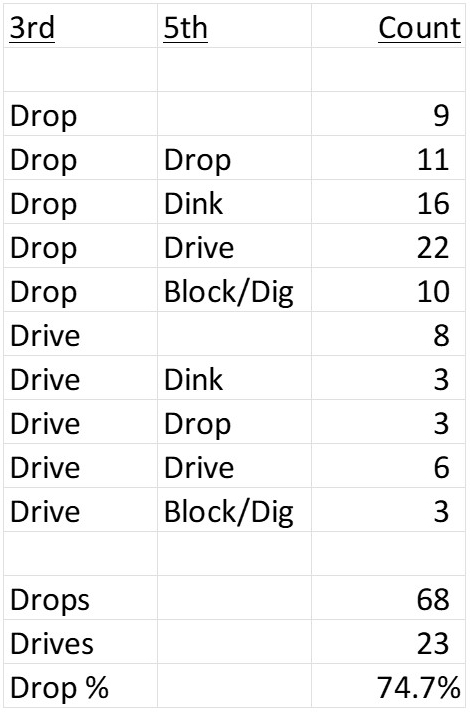
In this match, I charted shot selection on 3rd shot / 5th shot combinations. Here is the outcome of the analysis – discussion follows.

3rd Shot / 5th Shot Selection Table

In the match, nearly 75% of 3rd shots were drops, with about 25% being drives.

Let’s evaluate drop shots. If one of the four players hit a 3rd shot drop, there were possible 5th shots.

  • Drop / Blank = There was no 5th shot, either the 3rd shot was errant or was a winner, or the 4th shot was errant or a winner.
  • Drop / Drop = 3rd shot drop, then from mid-back court a 5th shot drop was attempted.
  • Drop / Dink = Successful 3rd shot drop, yielding a 5th shot dink.
  • Drop / Drive = After 3rd shot drop, the 5th shot was an attack shot off of a high 4th shot.
  • Drop / Block-Dig = 3rd shot drop, then a very defensive 5th shot from mid-back court (or being tagged by a 4th shot forcing a block).

Obviously a good outcome (other than hitting a 3rd shot drop winner, which is nearly impossible at the pro level) is to achieve a Drop / Dink outcome. This happened just 16 times out of 68 drops.

Another good outcome is to achieve a Drop / Drive outcome (suggesting the 4th shot was high). This happened 22 times out of 68 drop shots.

Both of those outcomes represent a reasonable outcome … happening 38 out of 68 times.

Hitting a 5th shot drop isn’t a bad outcome, but it is more defensive. That happened 11 times out of 68.

3rd Shot Drop / 5th Shot Block-Dig happened 10 times out of 68. This is a poor outcome.

I was very surprised by the amount of attacking done off of 3rd shot drops … 32% of the time the 3rd shot drop was followed by an attack. The attack was usually initiated (though not always) but the player NOT hitting the drop shot. This player cheats up toward the kitchen, looking to pounce on opportunities.

Here’s the series of outcomes off of 3rd shot drives.

  • 3rd Shot Drive / No 5th Shot = 8 out of 23 drives. Either the 3rd shot drive resulted in an error, or it resulted in a winner, or it resulted in a 4th shot error. 35% of 3rd shot drives ended quickly.
  • 3rd Shot Drive / 5th Shot Dink = 3 out of 23 drives. This is a good outcome.
  • 3rd Shot Drive / 5th Shot Drop = 3 out of 23 drives. This is a reasonable outcome.
  • 3rd Shot Drive / 5th Shot Drive = 6 out of 23 drives. This is “attack mode”, mostly initiated by attacks from the player hitting the 3rd Shot Drive.
  • 3rd Shot Drive / 5th Shot Block-Dig = 3 out of 23 drives. This is not a great outcome … typically the 4th shot is a block that points at the feet of one of the members of the serving team.

Among 3rd shot drop points that reached a 5th shot, 27% were drop/dink, 19% were drop/drop, 37% were drop/drive, and 17% were drop/block-dig.

Among 3rd shot drive points that reached a 5th shot, 20% were drive/dink, 20% were drive/drop, 40% were drive/drive, and 20% were drive/block-dig.

The percentages were really similar for 5th shots contingent on 3rd shot choice. About 4 times in 10 the team attempting the 3rd shot is able to generate offense on the 5th shot. That’s something I wasn’t expecting … I didn’t expect that much offense off of a 3rd shot (especially a drop).

Granted, this is a one-match sample dependent upon the players participating. Regardless, the data suggest an opportunity for us rec players to carefully generate offense off of high balls on 4th shots.

The Pickleball Game Flow Worksheet

Alright, let me show you something I am working on. I call it the “Pickleball Game Flow Worksheet”.

To keep things simple, I charted the first game of the PPA Women’s Doubles Bronze Medal match in Austin this weekend between Parenteau/Irvine and Koop/Johnson. You may click here to watch the match.

I may have missed one point during the game, which I charted while watching live. You’ll see the error in the attached image.

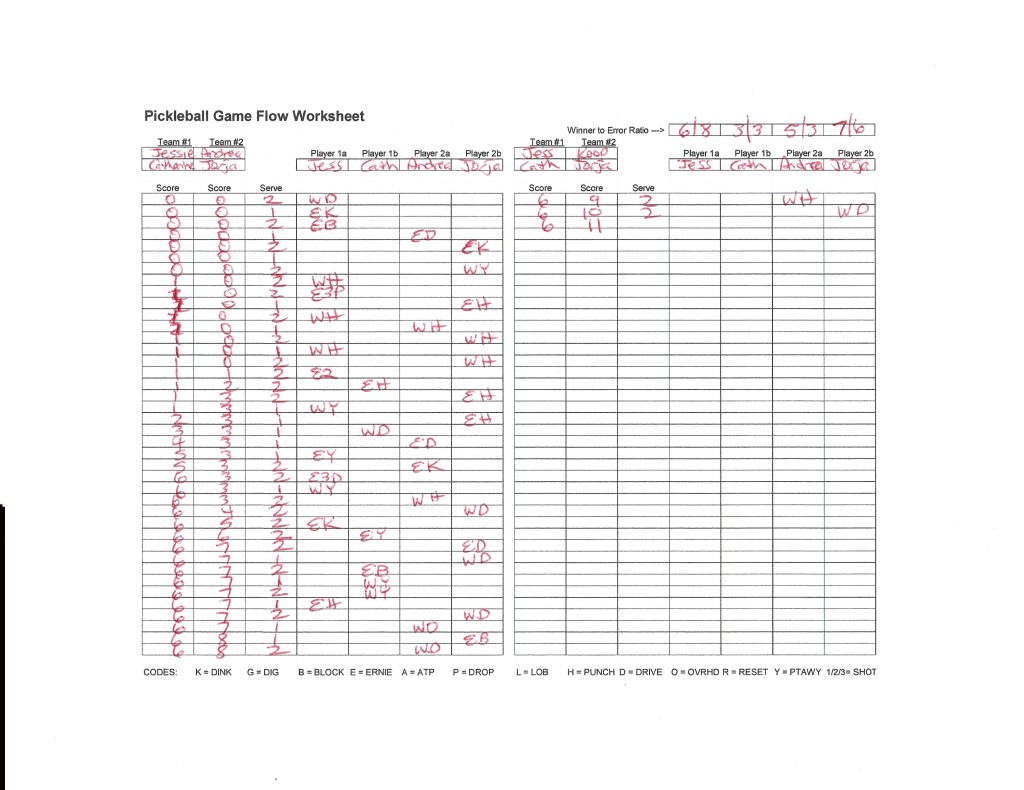
Here is the Pickleball Game Flow Worksheet.

Pickleball Game Flow Worksheet from Kevin Hillstrom

I chart the score and server (first, second). At the end of the point, if there was what I deemed a clear error, I coded the player with an “E” followed by the type of shot that the error happened on. For instance, if an error happened on a punch shot, I coded the error as “EH”. Labels for the type of shot are at the bottom of the image above. Winners are coded with a “W” … if a player had an overhead winner I coded the shot as “WO”.

On the upper right hand side of the image I summed winners and errors by player. This game was an 11-6 win for Koop/Johnson, and you’ll quickly observe that my favorite player (Jessie Irvine) has more errors than winners (in my opinion – your mileage will vary) and hit a return of serve out and had errors on a pair of third shots. We can see how Jorja Johnson was targeted more often than Andrea Koop, and she held her own!

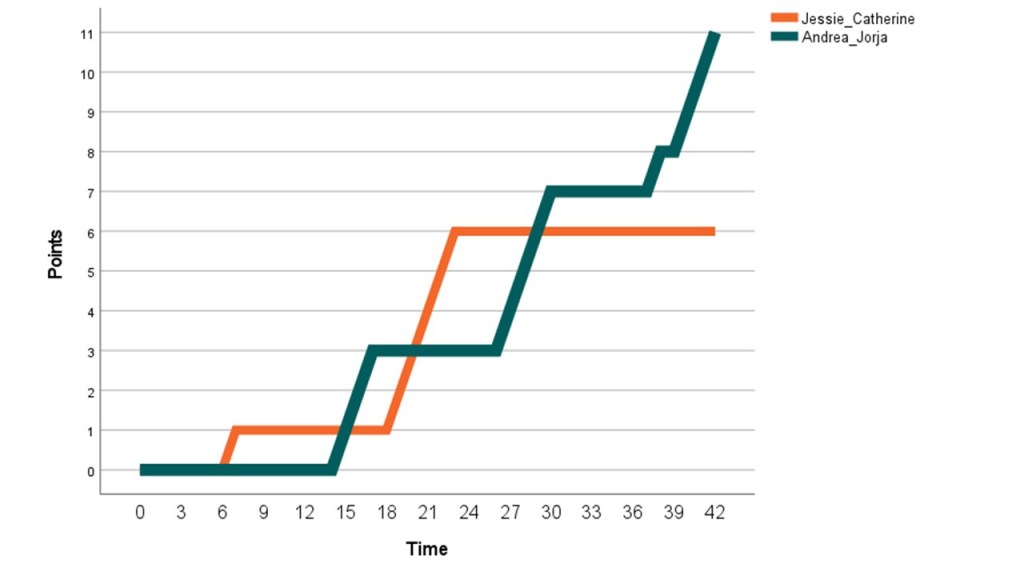
The worksheet allows me to show how the score progressed throughout the game.

Game Flow Scoring Graph from Kevin Hillstrom

Some say that pickleball is a game of runs. The image above demonstrates the runs in this game. Across 42 points we observe how Andrea/Jorja scored primarily during three separate runs, while Jessie/Catherine scored all but one point during one run.

Obviously the pros have sophisticated shot selections, combinations, and long rallies, all of which are oversimplified by this style of charting. Your amateur performance, of course, could benefit from this style of charting.

Let me know what you think … send me an email at kevinh@minethatdata.com

Thanks,

Kevin

APP and PPA

Less analysis here, more opinion today.

We’ve witnessed the success of Anna Bright over the past few weeks on the APP circuit (click here).

We see interesting dynamics between the two professional tours. On the one hand, the PPA largely has the best players locked-up. On the other hand, if the PPA has the best players locked-up, it’s hard to win there, causing developing players to play APP tournaments. You end up with APP being almost a “feeder league” for the PPA. Be it JW Johnson / Jorja Johnson / Vivienne David / Dylan Frazier … and others … you see how the two leagues can sidestep each other while serving a unique purpose.

3rd Shot Importance: Desert Ridge

I charted the five-game PPA thriller at Desert Ridge, featuring Callie Smith / Lucy Kovalova vs. Jessie Irvine / Catherine Parenteau.

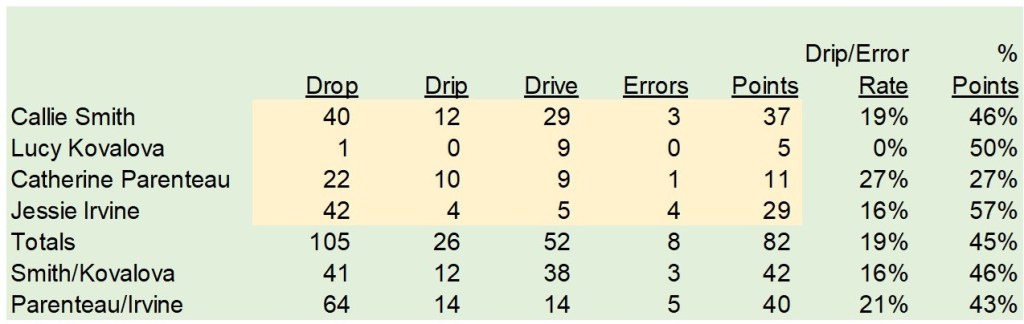
Specifically, I recorded shot selection (Drop, Drip, Drive) … a drip being a drop shot that is essentially chest/shoulder height, allowing the opposition to play offense off of the shot. I charted whether the team hitting the third shot won the point. I charted what I call “Error Rate” … simply defined as the percentage of third shots that were out, hit the net, or were drips.

Here are the results from the five-game match:

Look at Callie/Lucy’s data. Lucy rarely saw second shots hit to her. It was Callie’s job to set the tempo when her team served. She mixed drives with drop shots, and as the match progressed she shifted away from drives toward drop shots. Callie’s error rate was 19%, about the average for the match. However, Callie hits a lot of drives. Her drop shots occasionally became drips, so she offsets her error rate by hitting accurate drives.

Lucy never got the ball, did she? If she got the ball, 90% of her third shots were drives.

Lucy and Callie scored points 46% of the time off of third shots.

Jessie/Catherine had a different outcome. Jessie was targeted, especially early in the match. Eventually Callie/Lucy figured out that Catherine wasn’t having the best day. They began to target Catherine in the fourth and fifth games of the match.

When Jessie controlled the third shot, Jessie/Catherine scored points 57% of the time.

When Catherine controlled the third shot, Jessie/Catherine scored points 27% of the time. This was driven in part by the fact that Catherine had a 27% error rate on third shots (27% of the shots hit the net, went out, or were drips that could be attacked) whereas Jessie had a 16% error rate on third shots.

The shift in strategy (from hitting second shots to Jessie to hitting second shots to Catherine) paid off, as Callie/Lucy took home the title in Phoenix.

Chart the outcome of your third shots. Second shots and third shots represent opportunities to control the point. The pros actively target players and adjust strategy as the match progresses.

Dinking Statistics

We all know that dinking is an important skill. As a player progresses to higher ratings levels, dinking consumes more shots within each rally.

At the recent APP tournament in Mesa, I charted the outcomes of dinks in the first game of the Gold Medal match between Tereshenko/David and Irvine/Koop. Click on this link to watch the match.

I charted dinks for Irvine/Koop, and here is what I observed:

Andrea Koop:

  • 73 Dinks.
  • 2 Errors (into the net or out of bounds).
  • 8 Speedups (opponent attacked off of the dink).
  • Success Rate = (73-10)/73 = 86.3%

Jessie Irvine:

  • 31 Dinks.
  • 1 Error.
  • 2 Speedups.
  • Success Rate = (31-3)/31 = 90.3%.

Andrea was clearly being picked on. The data suggests she was nearly as steady as Jesse was.

When charting the data, I noticed that when the other team sped up a point off of a dink, the other team won the point 60% of the time. More on this in a second.

Had Jessie received the same number of dinks as Andrea received, Jessie would have had 2.4 errors vs. 2.0 errors for Andrea. Jessie would have had 4.7 speedups vs. 8.0 speedups for Andrea. If Jessie/Andrea only win the point 40% of the time after a speedup, I can calculate how much more effective Jessie’s dinks were than Andrea:

  • (2.0 – 2.4) + (8.0 – 4.7)*0.4 = -0.4 + 3.3*0.4 = -0.4 + 1.3 = 0.9.

In other words, had all of Andrea’s dinks been hit to Jessie instead, Jessie/Andrea would have earned 0.9 additional points during the game.

Whether you are a pro or a 3.5 player at your local club, you’d gladly take one additional point in a game up to eleven, correct?

Greetings!

How nice of you to be here!

My goal in launching Pickleball Analytics is to share statistics relevant to performance in the PPA, APP, and major tournaments. Obviously I’m biased toward the infinitely incomparable Jesse Irvine, and she will get her fair share of positive commentary here. But the goal is to be positive, to point out wins, losses, and great points/strategy.

Thank you for coming with me on this journey! Pickleball is the fastest growing sport in the United States. It is a place where people of differing opinions can agree to have fun, to compete, and to stay healthy. We’re going to talk about a lot of pickleball here. Are you ready?!!